
Sustainability is also becoming increasingly important for automotive customers. Porsche aims to take social responsibility that can transcend its obligations to the customers. The sustainability strategy is based on six strategic pillars: “Decarbonization”, “Circular Economy”, “Diversity”, “Partner to Society”, “Supply Chain Responsibility” and “Transparency and Communication”. Within these six strategic pillars, Porsche strives to advance its societal responsibilities, which Porsche believes will drive sustainable and value-creating growth while reducing negative environmental impact and continuously monitoring progress in this regard.
How is sustainability anchored organisationally at Porsche?
The Executive Board determines the strategic direction and specific sustainability targets, with the Porsche Sustainability Council, an independent group of external specialists, providing advice and guidance. The Sustainability department is responsible for the development and execution of the sustainability strategy including sustainability projects and the organisation of company-wide committees of Porsche AG.
The Politics and Society department manages sustainability communications and reporting, stakeholder dialogue, stakeholder management as well as the Porsche Sustainability Council. Various committees and teams set sustainability priorities and focus areas, consolidate sustainability measures across Porsche and develop and implement concrete sustainability measures and programs, among other responsibilities.
As electrification increases, so does the demand for lithium for high-voltage batteries. How is Porsche committed to environmentally and socially responsible mining of the raw material?
Porsche uses a „Responsible Supply Chain System” (ReSC) as a management approach to fulfill its human rights and environmental due diligence obligations. The ReSC system was developed at the Volkswagen Group and serves as an overarching due diligence approach for procurement.
The goal is to identify and avoid or minimize human rights and environmental risks along the supply chains based on a systematic risk assessment. It should also help to forestall violations and continuously improve suppliers’ sustainability contributions.
The ReSC system begins before a contractual relationship is entered into, i.e., before the agreement of specific delivery times and purchase prices. Together with the Volkswagen Group, Porsche identifies the sustainability risks that may arise from its direct business relationships. Indirect suppliers are also taken into account on an ad hoc and risk-related basis.
Furthermore Porsche has been involved in the "National Action Plan for the Implementation of the UN Guiding Principles on Business and Human Rights" (NAP) Automotive Sector Dialogue since 2020. One of the results of the sector dialogue was a baseline study on human rights risks in lithium production, based on an analysis of major lithium-producing countries. Based on this work, the Automotive Sector Dialogue developed recommendations for responsible practices at the mining and downstream company level. Porsche was part of the creation and publication of these findings.
In 2020, the Volkswagen Group initiated the "Responsible Lithium Partnership in Chile" together with several industry partners. Through this initiative, the Volkswagen Group was able to promote dialogue and gather input on the challenges faced by the local stakeholders concerned. In cooperation with various professional partners, Porsche also wants to improve its existing recycling processes to increase the proportion of raw materials in the cycle and reuse these materials in new batteries.
How does Porsche deal with high-voltage batteries when they can no longer be used in the vehicle?
Porsche's aim is to maintain the use of high-voltage batteries for as long as possible. Valuable raw materials remain in use for longer. This improves their CO2 balance. The ultimate goal is to ensure that the high-voltage battery can be used for the entire lifecycle of the vehicle without any complaints. Should a defect nevertheless occur, the 1:1 repair of the high-voltage battery by replacing the defective component (such as a battery module) is the most sustainable solution.
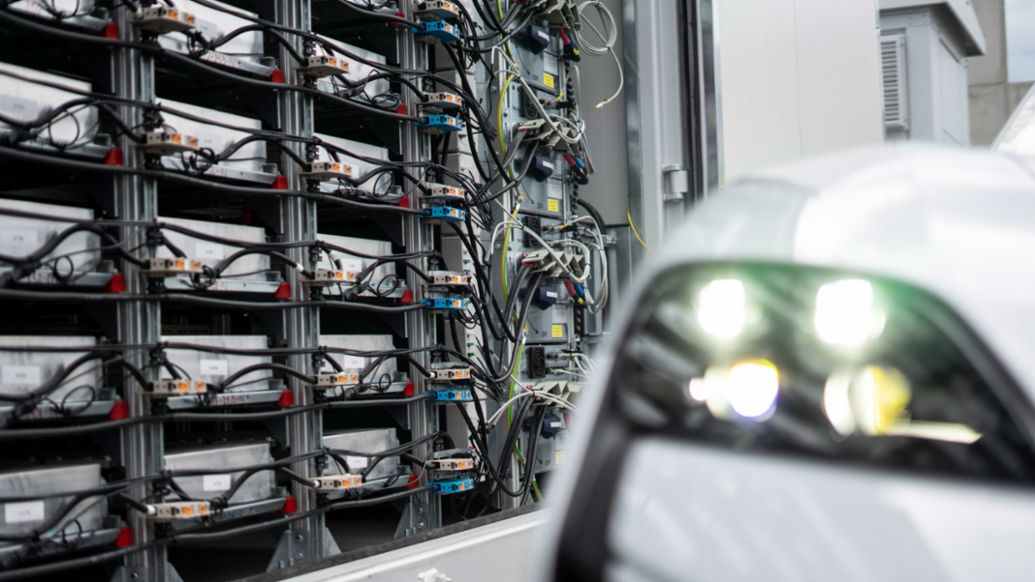
Porsche is also pursuing other options for the long-term use of battery resources. In the future, in addition to repair, Porsche will also be focusing on the reuse of cell modules - as a resource- saving option for long-term use in the vehicle. The reconditioning of spare parts is an established standard in the automotive industry (e.g. gearboxes, engines, etc.) and will also play an important role in relation to high-voltage batteries in the future.
This ensures cost efficiency on the customer side and conserves valuable resources that are used in the production of new batteries. Cell modules that are no longer suitable to vehicles can be used for 2nd life applications, such as industrial or home storage systems.
The cells and modules are only sent for recycling once all possible uses have been exhausted. Great importance continues to be attached to ensuring that the raw materials of the high-voltage battery are almost completely reintroduced into the battery production cycle.
What importance does diversity have at Porsche?
Porsche values to promote a corporate culture in which everyone is welcome and can contribute their skills to the best of their ability. To this end, for example, Porsche would like to further increase the mixed composition of teams throughout the organisation with the aim of bringing different perspectives together.
The company aspires to significantly increase the proportion of women in management positions by 2030: At company level, the proportion of women in the first and second management levels below the Management Board is to be increased to 28% and 22% respectively. At the end of 2025, the proportion of women at Porsche was 29.1% in the first management level (2024: 22%) and 18.7% in the second management level (2024: 18.8%). Porsche strives to continuously increase the proportion of women at all management levels in the long term.
How important is social responsibility to Porsche?
Porsche is involved in a large number of charitable initiatives in numerous countries via its “Partner to society” strategy field. It actively supports corporate citizenship projects, fundraising campaigns and social activities that are intended to benefit those people whose living environment is directly or indirectly connected to Porsche. Through targeted support and training, the personal life situation of young and disadvantaged people, who are confronted with various forms of difficult life circumstances, is to be improved long-term.

How do you ensure sustainability criteria in your leather supply chain?
Porsche aims to ensure that sustainability criteria are taken into account along the leather supply chain by imposing binding requirements on its direct suppliers. A specification sheet for leather obliges direct suppliers to ensure responsible production and processing, including with regard to avoid water pollution (e.g. during the tanning process). For example, direct leather suppliers must disclose the country of origin of the raw materials as well as the relevant production stages withing the supply chain.
Together with other brands of the Volkswagen Group, Porsche is a member of the Leather Working Group (LWG), an international non-profit organization that promotes greater transparency and harmonized environmental and social standards in the global leather supply chain and offers certification for leather manufacturers. Direct leather suppliers to Porsche are therefore additionally required to provide evidence that the respective production site has successfully passed an LWG leather-specific audit at the highest certification level (Gold Standard).
The use of raw hides, leather or upstream materials that are associated with deforestation or the destruction of protected areas is explicitly prohibited in the specification sheet. Confirmation of compliance with the requirements set forth in the specification sheet must be available at the time the contract is awarded.